
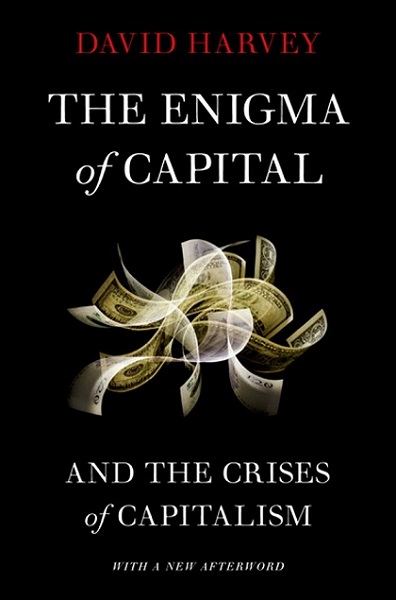
- Title: The Enigma of Capital And the crises of Capitalism
- Author: David Harvey
- Published: 2010
- Publisher: Oxford University Press; New York
- ISBN-13: 978-0-19-983684-0
David Harvey explains what the Capitalism is through a non-mainstream viewpoint.
Capital is not a thing, but rather a process that exists only in motion. When circulation stops, value disappears and the whole system comes tumbling down.
from the book
Capitalism is the political and economic system of the flow of Capital. It is fundamentally based on the “Continuous flow of Capital.” In order for Capitalism to succeed (to make capital flow without stopping), it requires an ever-increasing size of Capital (a 3% GDP increase is a mantra).
The problem occurs when capitalists seek strategies to achieve goals without legal and moral responsibilities – privatizing profits and socializing risks.
Capitalists want to maximize their profits, pure and simple. To achieve this goal, they want a continuous supply of cheap labor as well as bigger consumption.
Here comes the contradiction:
How can they achieve this: Lower-income and Higher-consumption at the same time? Lower-income was achieved through immigration (until the 1960s and 1970s) and through developing countries (later). Higher-consumption was maintained through marketing, debt, and notably the credit card industry.
According to Harvey, this fragile balance has been broken many times but saved through the sacrifices of many. This repetitive pattern leads to moral hazards and even bigger crises.
The question is left to us. We do not expect any revolution-like new structure will replace the current capitalist system any time soon. Still, we are responsible for our future actions to make our system more just and equal.


