
The basic concepts of Costs, Revenues, and Profits.
The following cover the basic concepts in the mainstream (Capitalist, neo-classical) Economics.
Costs
Total Costs (TC) = Fixed Costs (FC) + Variable Costs (VC)
The Law of Diminishing Returns
Marginal Product (MP) = (change in total output) ⁄ (change in the variable factor)
- Productivity will be reduced whenever the additional variable factor is added.
Marginal Costs
Marginal Costs (MC) = (Change in TC) ⁄ (Change in output)
- Marginal cost (MC) is the inverse of MP (Marginal Product).
- MC is the extra cost incurred when one extra unit of output is produced.
- Each additional factor leads to a higher cost -> Diminishing Return
Average Costs (AC)
TC = FC + VC
AC = TC ⁄ Q = FC ⁄ Q + AC ⁄ Q = Average Fixed Costs (AFC) + Average Variable Costs (AVC)
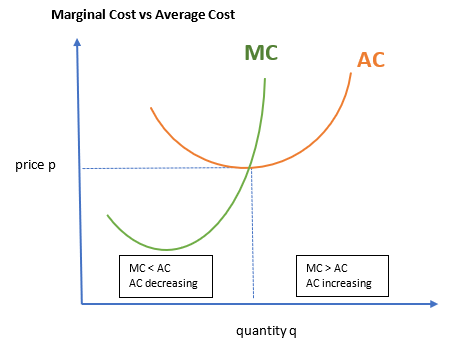
Marginal Costs (MC) vs. Average Costs (AC)
- MC > AC: pull AC up
- MC < AC: bring AC down
- MC will cross AC at the AC’s minimum point
Long-run Costs
- Economies of Scale
- The company can reduce the Average Costs (AC) when it produces more.
- Diseconomies of Scale
- If the company grows too large, it may find the AC begin to rise again.
- Minimum Efficient Scale (MES)
- The first point of output at which the long-run AC is minimal.
Revenues
Total Revenue (TR) is the measurement of sales.
Total Revenue (TR) = Price (P) × Quantity (Q)
Marginal Revenue (MR) is the difference in Total Revenue when an additional unit is sold
Marginal Revenue (MR) = (change in TR) ⁄ (change in Quantity)
Profits
Profit = Total Revenue (TR) – Total Costs (TC)
Profit Maximization
A company should stop producing at the point where Marginal Revenue (MR) equals Marginal Costs (MC)
- MR > MC: extra unit will make a profit
- MR = MC: no extra profit
- MR < MC: extra unit will be a loss

 Scriptorium