
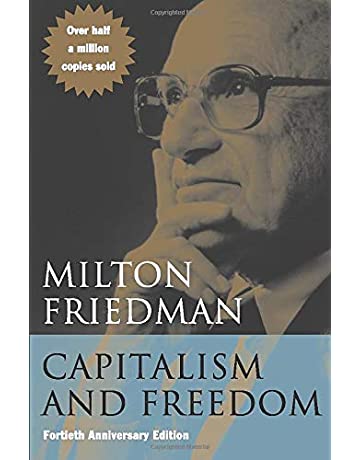
- Title: Capitalism and Freedom
- Author: Milton Friedman
- Published: 2002
- Publisher: University of Chicago Press
- ISBN: 0-226-26421-1
“Capitalism and Freedom” is Friedman’s most influential book on neoliberalism. The central theme of this book is to argue how to maximize freedom through the free market and a small government.
Main Ideas
- Restrict the role of government — the smaller, the better.
- Policing, national defense, and the protection of private property are the only necessary roles of the government; all others are unnecessary.
- Against Keynesian economic spending.
- The free market can solve all problems, including labor and schooling.
Criticism
Friedman argues that his ideas are based on freedom and result in an ideal democratic society. However, his experiments in South American countries turned out to be disastrous.
All economic models are restrictive — based on a framework that deals with limited variables and ignores others. Friedman’s idea lacks the most critical factor: human beings. He regards a human just like a one-dollar bill. This is an intellectual deception and nothing short of elitism. As Noam Chomsky mentions, he simply prioritizes the profit of the few over the many.
The most serious problem with this book is that it has remained so popular despite the logical pitfalls of most of its claims. Friedman’s arguments are generally taken out of context or deceptive. One example is his preference for a flat tax rate over a progressive tax rate; Friedman argues that by adopting a proper flat tax, total tax revenue can be increased. But the point of a progressive tax rate is not the total amount of collected tax money, but the redistribution of income. I do not think Friedman was unaware of this simple fact.
There are two important arguments that need to be mentioned:
- Adopting the free market might cause short-term problems but will result in long-term benefits.
- History shows the opposite, as we can see in South American countries. Many examples can be found in Naomi Klein’s “The Shock Doctrine“.
- The development of the Asian Tigers (Taiwan, South Korea, and even Japan) was due to capitalism and free-market policies.
- In his book “Bad Samaritans“, Ha-Joon Chang shows that the Asian Tigers actually developed their economies through protectionism and government-led industries.


