
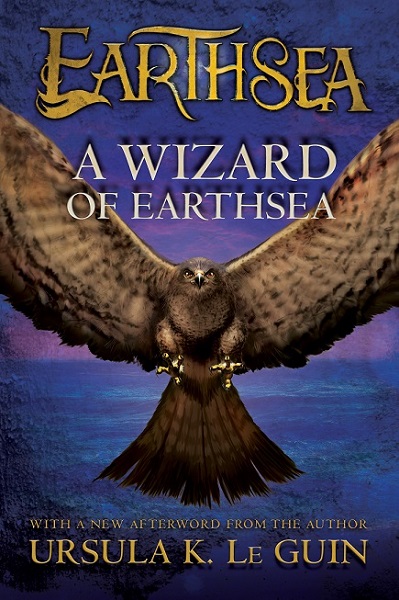
- Title: The Earthsea Cycle
- A Wizard of Earthsea
- The Tombs of Atuan
- Author: Ursula K. Le Guin
- Published (Publisher), ISBN:
- 1968 (Houghton Mifflin Harcourt), 978-0-547-72202-3
- 1970 (Simon & Schuster), 978-1-4424-5991-5
A Wizard of Earthsea
“A Wizard of Earthsea” is the first saga of Ursula K. Le Guin’s “The Earthsea Cycle.” It was written in the era of the liberation movements of the 1960s. It is no surprise to find clearly crafted messages throughout the book regarding topics such as race, gender, the conventional plots of genre novels, and social prejudices. The writing is highly modernist, which might be read as cliché from the 21st century’s identity-centric perspective.
The idea of a single, unique, or universal language before Babel still circulates. It was not just a myth or a children’s story for fun. Through the Middle Ages and even the classical era, people believed that we once had a universal language that contained markers of (and a direct relationship to) all objects in the world (as noted in Michel Foucault’s The Order of Things). Everything in Earthsea has its true name, which is not a mere signifier but the thing itself.
Wizards in Earthsea are not superheroes who can do anything at will. They have power that can only be used at the expense of something else. The book’s protagonist, Sparrowhawk, learns this lesson the hard way. He is not a hero fighting against a great evil or winning a war against bad people. He is fighting his own shadow, his own half, and the evil inside himself. His achievement is not a conventional victory; instead, he searches, discovers, and becomes who he is.
Speaking is power, but you can speak only in silence. After silence, there is an utterance.
The Tombs of Atuan
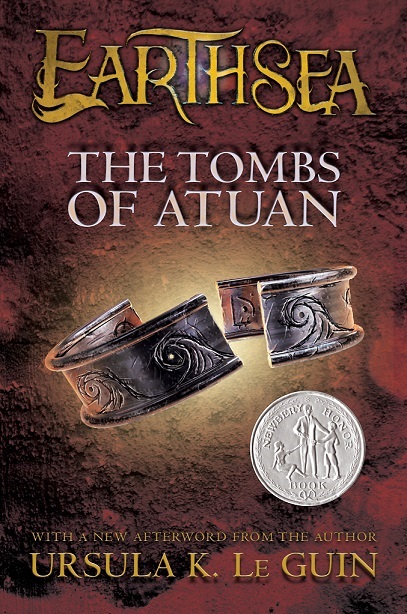
“The Tombs of Atuan” is the second saga of “The Earthsea Cycle”. Ged continues his journey to find the other half of the Ring of Erreth-Akbe. The first half was given to him by the old lady on the deserted island in the first book.
The story is not a heroic adventure to fight against evil and earn great treasure as a result. The protagonist of the second book is not our wizard Ged, but a young girl trapped in the symbolic role of a priestess. Her name was taken, and her fate was given. Ged is not a victorious wizard but a guide to freedom.
Freedom is not something given to you. Having the option to select from multiple choices is not freedom. When you choose of your own free will and take full responsibility for your choice, you are free. The main character (the young priestess) has to choose who or what she is; light with a name (Tenar) or the darkness without a name (Arha). She cannot be both, and her choice creates her own self.
The plot of the book penetrates the essence of existence. Human beings are the only animals that seek the answer to why we exist. We try to find what we are, but the essence of oneself is not something that is merely discovered or found. Your choice makes you!
Many might be unsatisfied with the gender roles depicted in the book. Why could Tenar not stand by herself? Why does she need help from a man? In the afterword, the author answers this question. We are not alone; one cannot achieve victory by oneself. Yes, the great wizard Ged survived with the help of Tenar. Tenar achieved her freedom with the help of Ged. But her argument seems a bit dated to me.


