
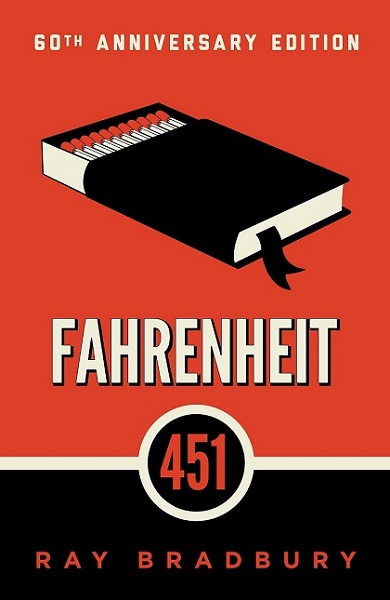
- Title: Fahrenheit 451
- Author: Ray Bradbury
- Published: 1951
- Publisher: Simon and Schuster
- ISBN: 978-1-4516-7331-9
The Burning of Books and Burying of Scholars (焚書坑儒) is a famous event carried out by the Chinese emperor Qin Shi Huang of the Qin dynasty. He ordered the burning of books in 213 BCE and the burying of many Confucian scholars alive. While the exact details of the event are debatable, we have heard of many similar incidents throughout history and in literature.
The power of books and knowledge is not a new idea. In the era of apocalyptic science fiction, it is not surprising to see a society with strict control over the press, media, and knowledge.
Ray Bradbury’s “Fahrenheit 451” is a pivotal example. Even though the book is frequently quoted and is regarded as one of the best SF novels ever written, the writing itself is somewhat disappointing. You should not expect the storytelling mastery found in the books of George Orwell. However, what is remarkable about the book is how its description of society mirrors the current 21st century after so many years.
Let’s check an interesting point: “Does paper really burn (auto-ignite) at 451°F (232°C)?” Bradbury mentioned that he got the answer from a fire station. Modern experiments show that paper’s auto-ignition temperature is actually between 440°F and 480°F, depending on the material, volume, and density.
You might encounter the name Fahrenheit 451 from François Truffaut’s classic 1966 movie or the more recent HBO adaptation. It is interesting to see how these films reinterpret the original, but I have to admit the adaptations did not successfully capture the terrifying “Mechanical Hound” from the novel.


