
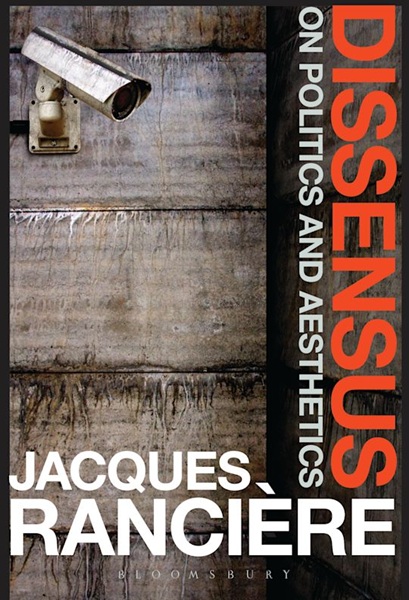
- Title: Dissensus on Politics and Aesthetics
- Author: Jacques Rancière
- Published: 2010
- Publisher: Bloomsbury
- ISBN: 978-1-84706-445-5
It is often challenging to grasp how Jacques Rancière conceptualizes democracy and how it intertwines with art and aesthetics. His book “Dissensus: On Politics and Aesthetics“, a collection of essays, serves as an entry point to understand how he elaborates these ideas.
The “Police” Order vs. Politics
A major obstacle to understanding Rancière’s philosophy is, as he himself frequently emphasizes, the confusion between what he calls the “Police” (la police) and “Politics” (la politique).
- The Police Order
- When we view democracy as a political system, a bureaucratic government, or an institutional structure, we miss Rancière’s point entirely.
- For him, institutions, elections, and state administrations belong to the “police order” — a rigid system that assigns roles, places, and hierarchies to people in a society.
- Politics
- Politics is not a system we live under or a set of rules we agree upon. Instead, politics is a temporary, disruptive moment that challenges the police order. It occurs when those who have “no part” in the social hierarchy demand to be heard and disrupt how the “sensible” (what can be seen, heard, and perceived) is distributed.
Consensus and Dissensus
To maintain social order, the “Police” relies on Consensus. Consensus is an agreement on how society works, but it often creates a rigid, stagnant environment that cannot address underlying injustices. In a consensual society, any ideas or voices that fall outside the established norm might be ignored or rendered invisible.
This is where Democracy plays its role:
- The “Redistribution of the Sensible“: Democracy is not a type of government; rather it is a disruptive force that reshapes what is seen and what is heard.
- Dissensus: The moment of this rupture is what Rancière calls dissensus. Dissensus is not just a disagreement or a debate; it is a fundamental clash between two different sensory realities. It reveals a new voice amd forces society to recognize it.
Art, Aesthetics, and the Double Regime
There is an ongoing debate regarding the place of art in society, typically split into two:
- Autonomy: Art stands on its own, separate from politics, with its own independent purpose and domain (“art for art’s sake”).
- Heteronomy: Art cannot be separated from social life, meaning art and society constantly influence each other (“Art becomes Life” or “Life becomes Art”).
Rancière points out that this entire debate is central to how the Aesthetic Regime of Art operates. For him, art is simultaneously autonomous and heteronomous.
Art is unique because it maintains its independence (autonomy) while actively reshaping our shared social reality (heteronomy). Moreover, the most important feature of aesthetics is that it acts as a primary driver for redistributing the sensible. Act of Art, in itself, triggers dissensus, making it an inherently democratic movement.


