
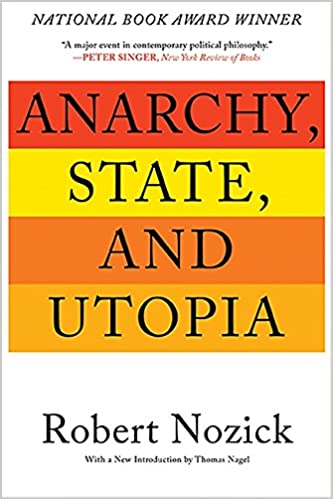
- Title: Anarchy, State, and Utopia
- Author: Robert Nozick
- Published: 1974
- Publisher: Basic Books, New York, 2013
- ISBN: 978-0-465-05100-7
The minimal state is the most extensive state that can be justified. Any more extensive state will violate persons’ rights not to be forced to do certain things, and is unjustified.
from the book
The debate about “Justice” between Rawls and Nozick in the 1960s and 1970s has inspired many thinkers to consider how morality can affect the social system and the role of the state.
Taking the side of liberation thought, Nozick embarked on a dangerous and challenging journey to promote the idea of how a minimal state can be not only just, but also the only option to ensure a free society without violating human being’s basic rights.
Rawls’s central assumption – All human beings have the basic conditions to be a human, which cannot be violated and must be supplemented to meet these conditions – is quite convincing. Justice is based on equality. How can Nozick attack this common-sensical egalitarian argument?
Nozick’s main idea is a minimal state, which is based on the notion that everyone should have maximum freedom alongside the protection of individual rights. The purpose of the state is to guarantee that no member violates others’ rights. Therefore, the minimal state is limited to protect against fraud, theft, force, and the enforcement of contracts.
Nozick compared various types of states such as individual anarchist communities, socialist states, and even utopian communities. His main argument is that any organization bigger than a minimal state violates individuals’ rights that cannot be compromised. And any state that violates human rights cannot be a just one. It is a powerful argument that cannot be easily refuted but is not a convincing one at the same time.
I am feeling uncomfortable with Nozick’s idea, even though his argument is very logical. The problem lies in the concept of society and logic. Social life cannot be reduced to logical arguments and numbers. I fully agree on the Nozick’s fundamental human rights – individual space and property protection. They are indispensable, but we are social animals who live with others. As Rousseau said, we already passed the point where we can live individually.
Nozick’s idea of the basic human condition is too materialistic and individualistic. The social contract between a state and its members is neither static nor concrete. We ask for our rights while also taking responsibility. We have to keep an eye on our contracts. The condition of being a human has been changing in this complex social web, and we are more than a rational thinking machines that act only according to our interests, profits, and ownership.
The minimal state can only be just and equal if we are exactly the same. I do not advocate the complete equality of the end result. But a just society should provide all members with an equal starting point, such as a universal education system. The state should also have the minimum welfare net in case of the members’ failures or misfortunes by providing a universal health system, employment insurance, and compensation for low-income members.


