
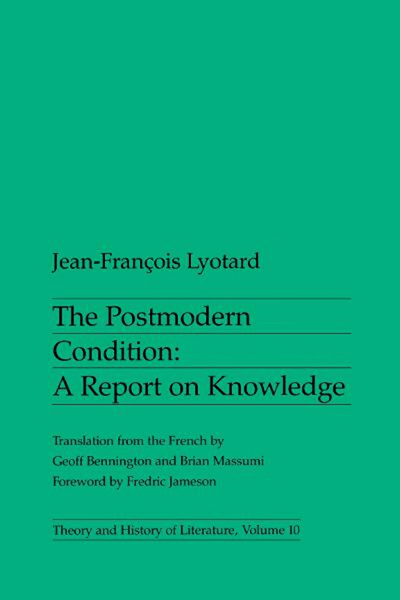
- Title: The Postmodern Condition: A Report on Knowledge (La condition postmoderne: rapport sur le savoir)
- Author: Jean-François Lyotard
- Translated: Geoff Bennington & Brian Massumi
- Published: 1979 (French), 1984 (English)
- Publisher: University of Minnesota Press
- ISBN: 0-8166-1166-1
The first essay examines the state of knowledge in the late 20th century alongside the development of science and technology. Scientific knowledge is a kind of discourse (communication through language) rather than mere descriptions of facts. Knowledge takes the form of quantifiable information packets, and anything that cannot be digitalized risks being discarded.
Knowledge involves two main functions: research (acquisition) and transmission. The most important shift of the postmodern age is the changing nature of knowledge. Knowledge ceases to be an end in itself (losing its use-value) and becomes a commodity (produced to be sold for exchange-value). Both acquisition and transmission are now part of a process of producing knowledge for sale.
A problem arises when corporations, rather than the public, become the owners of knowledge, which translates into power. Additionally, computerized systems reshape how societies and states store and share knowledge, raising the question of who decides what counts as valid knowledge — a legitimation crisis.
Lyotard proposed that “language games” are rule-governed forms of communication used to determine how statements are made and legitimized. He especially focused on how two primary types of discourse (language games) — narrative and scientific — clash. In the computerized information age, grand narratives, such as Enlightenment reason or Marxist class struggle, have lost ground and a network of localized language games creates a new, dynamic social environment.


