
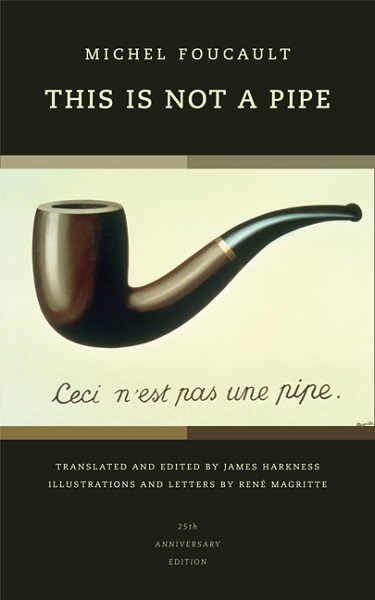
- Title: This is not a pipe – “Ceci n’est pas une pipe”
- Author: Michel Foucault
- Translated: James Harkness
- Published: 1983
- Publisher: University of California Press
- ISBN: 978-0-520-23694-3
Ceci n’est pas une pipe.
How words (language) linked to objects? This is the question that Foucault tried to answer in his masterpiece “Les Mots et les Choses,” which translates to “The Order of things.”
It had been thought that language and reality were bonded together mystically. Ursula K. Le Guin portrayed this myth very clearly in her “Earthsea” novels.
In Saussurean linguistics, words do not refer to things. A Word is arbitrarily assigned to an object and conveys meaning through graded differences within a network of other words.
A day will come when, by means of similitude relayed indefinitely along the length of a series, the image itself, along with the name it bears, will lose its identity
from the book
Magritte’s Surrealism reinterprets the mystical link among images, language, and things in a different context. His images are familiar but rendered irrationally or senselessly. This non-representational quality of Magritte’s images overcame the boundaries of representation, making things adrift and freeing from their signifiers.
Let’s get to the point. What happens when you see the painting, “This is not a pipe”? You know you are looking at a pipe, a representation of a real pipe. In a Platonic sense, it is a copy of the real one. How do you recognize the image as a pipe? You have seen a pipe (in real life or in a picture), and your brain has created a mapping between a signifier “pipe” and the qualities of what a pipe means. After that, even when you see different types (shapes) of pipes, you can reconnect the mapping.
Now, the image is before your eyes. You recognize that it is a pipe, more correctly, the drawing of a pipe. But the text underneath it gives an impression of contradiction and paradox: “Ceci n’est pas une pipe.” It is a very true statement that breaks down our automatic mental processes. We recognized “This is a pipe” and “This is not a pipe” at the same time without any contradiction. Only when the text gives the emphasis to the latter, we get a different impression: a vague uneasiness.
The book “This is not a pipe” is about Foucault’s continuous pursuit to understand power and social relations. He assumes René Magritte in a historical line of Klee and Kandinsky that challenged the established system of images, symbols, and text. They freed painting from resemblance and affirmation – the classical sense of painting.
You might disagree with Foucault’s highly opinionated homage to Magritte. I saw most of Magritte’s works at the MOMA galley (https://www.moma.org/artists/3692). My expression was mixed; impressive, but somewhat too expressive and rather superficial. Stiil, I have to appreciate Foucault’s rather provocative view, which gave me a chance to look at Magritte’s classics works in a different context.


