
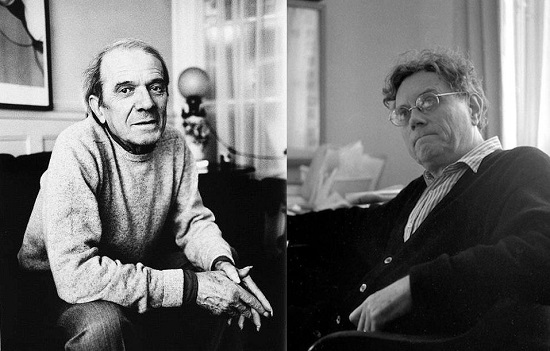
- GILLES DELEUZE (1925 ~ 1995), FRANCE
- FÉLIX GUATTARI (1930 ~ 1992), FRANCE
Gilles Deleuze, a philosopher, and Félix Guattari, a psychoanalyst, wrote a number of works together. Their collaborations marked a significant progress of post-structuralism.
CONTINUITY OF THE SENSIBLE AND THE INTELLIGIBLE
- Reversal of Plato
- From Plato, Philosophy seeks the essence (general, intelligible) from experiences (particular, sensible). This discontinuity is the enemy of metaphysics.
- Discontinuity is based on the good sense (one direction) and the common sense (stable entities). Philosophy has tended to amplify discontinuity.
- Continuity has no direction and is not stable.
RHIZOME
- The tree is the symbol of discontinuity. Rhizome is continuity.
- Trees reveal the deep structure, but Rhizomes are just the messy reality (no direction, no beginning or end).
- Trees are connected based on hierarchy. Rhizomes, which are heterogeneous, multiply connections and create new something.
ASSEMBLAGE
- An assemblage is the interconnection of heterogeneous multiples.
- An example is language. Language is a heterogeneous mixture of words, power, people, and geography. There are no discontinuous points between components.
PSYCHOANALYSIS AND SCHIZOANALYSIS (ANTI-OEDIPUS)
- Freud found Rhizomes in the unconscious, but was determined to see a tree (discontinuous essence, which points to a single point, Oedipus).
- Deleuze and Guattari propose Schizoanalysis (eruption from every assemblage).
- Unconscious is multiplicity, which are statistical aggregates.
- Multiplicity cannot be reduced to linear causality but only be treated accordingly to statistical probability. (An example of multiplicity is weather prediction.)
BODY WITHOUT ORGANS
Body Without Organs is on which multiplicities circulate. It is not a space but the continuum of life itself.
THINKING, TECHNOLOGY, SIMULACRUM
- Traditionally, technology is added to life. Thinking in human life (thinking, remembering, imagining) is given by default, and technology is an extension.
- The idea of technology as a supplement (secondary to living) produces a limited understanding of virtual.
- The simulacrum is not a secondary image of life, but life (reality) itself.
- The question is neither “what can we know?” nor “how accurate are our senses?”. Life is as an active imaging, not as a passive perception.
- Thinking delays the immediate relation of brains to living matter. Thinking acts upon the virtual images and allows the images in all their complexity and difference.
- Consciousness is a slowing down or delay of thinking, which allows the past to be carried over into the present.
- Technology allows us to create new connections and to maximize our own potential.
PHILOSOPHY
- The active creation of concepts is important.
- Do not accept existing ideas as good or common sense.
CAPITALISM
- Capitalism is a radical deterritorialization.
- positive possibility – (anything is allowed to change) and reterritorialization
- negative possibility – (all changes are related to a single maxim, money)
- Privatization is the formation of flow with neither specific meaning nor identity (the same, whether it is mine or yours).
- Time is privatized in Capitalism.


