
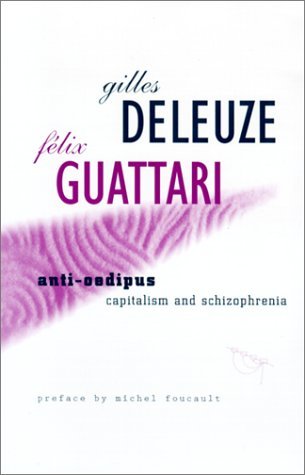
- Title: L’Anti-Oedipe, (Anti Oedipus, capitalism and schizophrenia)
- Author: Gilles Deleuze & Félix Guattari
- Published: 1972
- Translated by: Robert Hurley, Mark Seem, and Helen R. Lane
- Publisher: University of Minnesota Press
- ISBN: 978-0-8166-1225-3
The book is about Ethics and provides the guide against Fascist life.
Preface by Michel Foucault
Authors start with what three basic ideas that mid-20th intellectuals needed to know:
- Class struggles by Marx
- Desire and subconscious by Freud
- Symbols and text (Semiotics) by Ferdinand de Saussure
It is very important for 21st-century readers to grasp the meaning of mid-20th-century European political and philosophical writings. Marx’s ideas have not been successfully materialized (yet, perhaps), Freud’s ideas may no longer be recognized as the standard psychological treatment, and Saussure’s ideas are known mostly within the circle of scholars. Yet 20th-century intellectuals are all based on these quite radical understandings of individuals and groups.
“Anti Oedipus” by Deleuze & Guattari attacked these foundations and reorganized our reality again.
The first problem is Reductionism. Modern philosophy and science tend to reduce reality to general rules and ideas. But the reality is not based on stable rules. It erupts, explodes, and flows.
On the other hand, they questioned whether people do want to be led by ideologies. Why Fascism prevailed? The solution is from Nietzsche: Herd psychology/morality. But the unworldly superman is not an answer.
Individualism is not the opposite of Fascism. It is rather an extreme form of Fascism based on the Ego. American Individualism is only about what I have: properties and family.
Now we can return to Marx and Freud.
- Ego blocks the flow of desire.
- Desire is not a lack. It does not stem from a lack either.
- Capitalism organizes needs (lack) as a function of the market economy.
- Desire has been regarded negatively, as mere fantasy. It becomes a victim in the process.
The point is that desire produces reality. Desire needs to be flowed and regarded positively.
Desire
Lacan said desires are chasing “objet petit a” (object little a) in the Real order. When we desire, we want what we cannot attain. Desires have been considered negatively. Desire is a lack, a hole, and something you have by your greed and stupidity. But Deleuze and Guattari want to look at desires in a positive way. Desire is productive and is what makes all machines (everything) operate.
Body without Organs (BwO)
D+G oppose organisms that are structured. Because the BwO is not structured and can flow dynamically, it can become any structure (productive). The “Body without Organs” is like an egg; it holds potentials.
Need, Desire, and Capitalism
Lacan points out that desire refers to “objet petite a” (something you cannot symbolize). Therefore, desire leads to fantasy. But G+D emphasizes that desire is real and produces things. Capitalism manipulates desire. It converts desire into needs so that you can spend. Capitalism itself blocks the flow, but by reorganizing the structure, it keeps surviving.


