
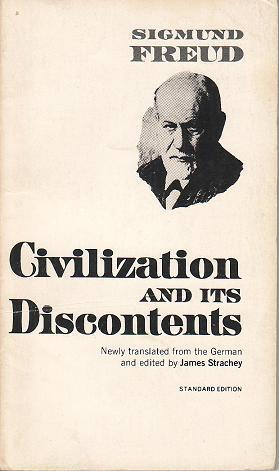
- Title: Civilization and its Discontents
- Author: Sigmund Freud
- Published: 1929
- Translated by: James Strachey
- Publisher: W. W. Norton & Company (1962)
- ISBN: 978-0393096231
“Civilization and its Discontents” is a work of cultural psychology that examines the tensions between individual freedom, drives, and the demands of organized society a.k.a civilization.
The Role of Religion
Freud reiterates his assertion that religion as an oceaninc intoxication is a mass illusion designed to comfort humans against the terrifying helplessness. It offers infantile solace and enforces moral order, but ultimately prevents humanity from maturing and facing reality directly.
The Source of Human Suffering
The Triad of Misery and the Paths We Take to Endure
Freud argued that human suffering arises from three primary sources:
- the frailty of our own bodies
- the overwhelming power of nature
- the hardship of human relations.
To cope with everyday pain, we choose one or a combination of following three paths.
- Deflection or Avoidance.
- The pursuit of Substitutes, such as art, a career, or hobbies, to compensate for the distress.
- Intoxication, which is often the most effective, found by following predefined paths through religion or tight-knit communities.
This framework ties directly into the search for meaning in life. We can avoid existential despair by retreating inward, much like the conclusion of Voltaire’s Candide: “Il faut cultiver notre jardin” (We must cultivate our garden).
Alternatively, we can achieve small victories through everyday activities, even while acknowledging the absence of a grand, cosmic meaning. Finally, we can accept the ready-made answers provided by our religion or social groups.
Core Premise
Civilization requires individuals to suppress their most primitive instincts— aggression & sexual or pleasure-seeking drives— in order to maintain communal order and peace. This forced repression is the primary source of human unhappiness and psychological malaise.
The Conflict Between the Individual and Society
Freud posits two primary opposing drives within human nature
- Eros: the life instinct, seeking connection, love, and creation
- Thanatos: the death/destruction instinct, manifesting as aggression toward oneself and others
The Cost of Progress
While civilization protects us from nature and each other, it demands people redirecting their natural instincts, eros and aggression . Society creates a constant state of internal conflict.
The Turn of Aggression
The relationship between society and its members is a contract. While society prohibits direct aggression against others, individuals have to redirect primal aggressive energy (death instinct) inward. This internalized aggression becomes the superego (conscience), which punishes the ego with guilt whenever aggressive or forbidden thoughts arise. Consequently, the more civilized a person is, the harsher their internal guilt tends to be.
The tone of Freud’s narrative seems pessimistic. His focus is the conflict and tension between civilization’s demand for order and human beings’ aggressive drives. The ongoing struggle between life (Eros) and death (Thanatos) dictates the trajectory of human history, letting modern individuals permanently torn between the safety of community and the misery of repressed freedom.


