
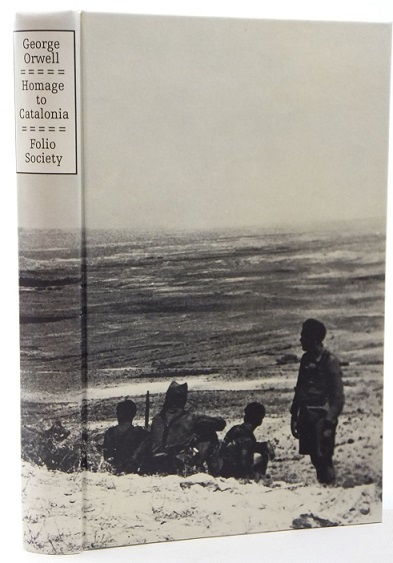
- Title: Homage to Catalonia
- Author: George Orwell
- Published: 1938
- Publisher: The Folio Society, London (1998)
The Spanish Civil War has not been a popular subject, and I only had a fragmentary notion of it. George Orwell’s vivid illustration of his experience in the war surely ignited my curiosity to know more about what really happened.
I recently watched and read “All quiet on the western front” – the novel by Erich Maria Remarque (1929), and the movie directed by Lewis Milestone (1930) -, which made me feel shocked (the first time), then sad (the second time), and finally uneasy and disturbed. Is this the world in which I live? Being or becoming pessimistic cannot be an option, but there seems to be no way around it.
“Homage to Catalonia” is neither a systematic synthesis of politics nor an impartial history. But through it, I can see hope and the possibility of human society and my own existence. What attracts me is not how the war progressed or how cruel the situation was, but how the anarchists were able to rise up in the real history. A socialist society is often regarded as a fantasy, or even against basic human conditions. We accept capitalism as democracy and regard socialism as a joke. Why are we afraid of equality? Is it really against our instincts? Or are we just stupid mass controlled by big ideologies and propaganda?
George Orwell was crushed in the Spanish Civil War. His naïve optimism stumbled upon complex political feuds. But he experienced what the Spaniards had achieved, even if only for a short period. Workers in CNT (Confederación Nacional del Trabajo) were not equipped with intellectual ideologies. They were called anarchists, but they did not define themselves as such. Equality and freedom were the products of their brave actions. It was a real revolution, as Orwell affirmed in the book.
George Orwell concerned about the power struggles among anti-fascist groups (pro-republicans).
- POUM (Partido Obrero de Unificacion Marxista – Workers’ Party of Marxist Unification): Trotskyist Intellectuals
- CNT (Confederación Nacional del Trabajo – National Confederation of Labour): anarcho-syndicalist labor unions
- FAI (Federación Anarquista Ibérica – Iberian Anarchist Federation): Anarchist political group in CNT
- PSUC (Partit Socialista Unificat de Catalunya – Unified Socialist Party of Catalonia), PCE (Partido Comunista de España): Communist Party
- UGT (Unión General de Trabajadores – General Union of Workers): Socialist labor unions
At the early stage of the civil war, they worked as separate units: CNT, PSUC, and POUM. When the Republican government tried to reorganize all anti-fascist troops and militias under the communists (backed by the Soviet Union), the conflict among the groups was inevitable. The first victim was the POUM and then the CNT.
It was a sad history. It showed the possibility of different social structures but was crushed by existing (and maybe worse) structures. Since then, we haven’t seen this kind of eruption of the will for human freedom. Even though it is just nostalgia now, George Orwell left us a vivid image of what human beings might have achieved.


