
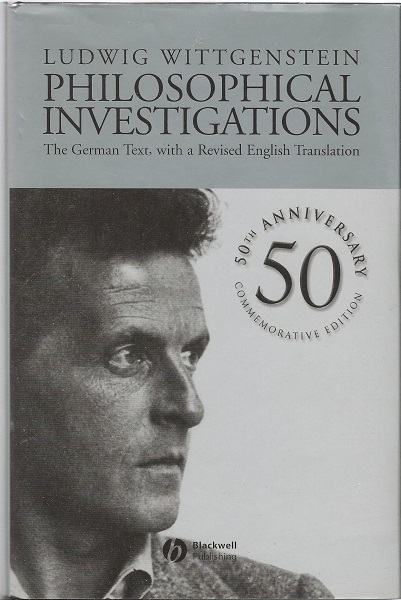
- Title: Philosophical Investigations
- Author: Ludwig Wittgenstein
- Published: 1953
- Publisher: Wiley-Blackwell; 3 edition (Dec. 2001)
- ISBN-10: 0631231277
- ISBN-13: 978-0631231271
In his earlier work, “Tractatus Logico-Philosophicus,” Wittgenstein focused on analyzing language through a critical lens. He attempted to define the limits of language; by clarifying its use and meaning, he believed it was possible to see what philosophical problems are.
In “Philosophical Investigations,” Wittgenstein broadened his view of language and speech. Instead of abandoning his previous views, he shifted his focus to how language functions across different settings. Language is not just a direct mapping between words (signifiers) and meanings (signified). Rather, it functions in many different ways depending on how it is used, or what kind of “language game” you are playing.
Wittgenstein believed he had solved all the major problems of philosophy after writing the “Tractatus.” However, he later realized his original theory was too rigid and began exploring how language works beyond a simple chain of significations. He acknowledged that the meaning of language is determined by its use within a context, not by direct representation. Language is a dynamic toolbox used to accomplish specific tasks.
As a philosophy book, it is relatively easy to read, yet simultaneously difficult to digest. Wittgenstein continuously asks fundamental questions — questions that are so obvious they seem impossible to answer. Reading it feels like being asked “Why does 2 + 2 equal 4?” over and over again. Unlike his previous abstract contemplation, Wittgenstein used many concrete examples; however, these are not meant to merely explain or augment his ideas. For him, it is easy to see what he wants to say through concrete, real-life situations, but incredibly hard to explain those concepts through abstract text. His only way to write about what cannot be said is simply to show reality to the reader.
If you want a genuine taste of what it feels like to philosophize about your own life, this is exactly why you need to read this book.


